Broadening Art-Science collaboration through Design in Trends in Biotechnology publication.
A new publication in Trends in Biotechnology presents recent work from Luis Quijano, Cristiano Pedroso-Roussado (ITI-LARSyS), and Enza Migliore.
In “Broadening art–science collaboration in biotechnology: integrating design,” the authors advocate for the evolution of transdisciplinary research by integrating design as a generative partner within the laboratory. This paradigm shift is of critical interest to biotechnologists, design practitioners, and researchers seeking to move beyond traditional silos toward a model of collective innovation.
The study highlights the emergence of biodesign as a transformative practice utilizing biological organisms, such as bacteria and fungi, to develop novel materials like bacterial cellulose-based textiles and mycelium-based composites. Through high-impact case studies including the Bio-Tile project’s living architectural membranes, the BactoHealing project’s bacterial material repair, and one of the Bauhaus of the Seas residencies focusing on regenerative oyster shell tiles, the authors demonstrate how “material tinkering” enables early-stage hypothesis testing and the inclusion of more-than-human frameworks.
Supported by the Fulbright Future Scholarship, the Australian Government Research Training (RTP) Scholarship, the Horizon Europe Bauhaus of the Seas project, and the Fundação para a Ciência e a Tecnologia, the work argues that establishing shared lab spaces and joint mentorship is essential to transform biotechnology into a mature research paradigm capable of addressing 21st-century environmental challenges.
Article:
Broadening art–science collaboration in biotechnology: integrating design
DOI: https://doi.org/10.1016/j.tibtech.2025.12.014
Free access (50 days): https://authors.elsevier.com/c/1mV1Jc9XEr9Gl
Authors:
Luis Quijano (joint co-first author)
Cristiano Pedroso-Roussado (ITI-LARSyS) (joint co-first author)
Enza Migliore
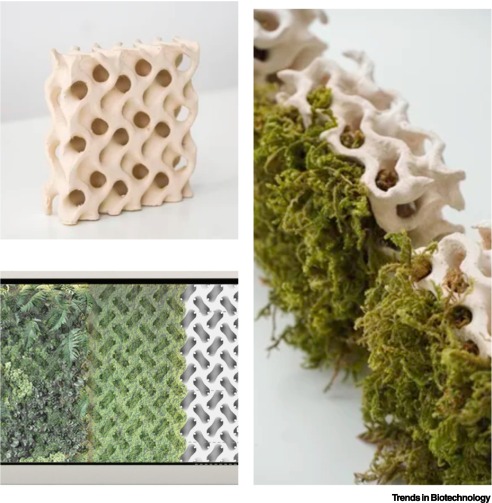
Image: ‘Bio-tile: Biodesign and Microbial Life in Architectural Practice’ (Enza Migliore and Ran Che).
Top left panel: Prototype of the 3D-printed porous ceramic bio-tile structure. Bottom left panel: Design sketch showing potential integration, surface growth, and application within a microclimate-regulating wall system. Right panel: Moss successfully integrated into the tile, illustrating living and material fusion with design. Image reproduced with permission from the Materialities lab (2025).