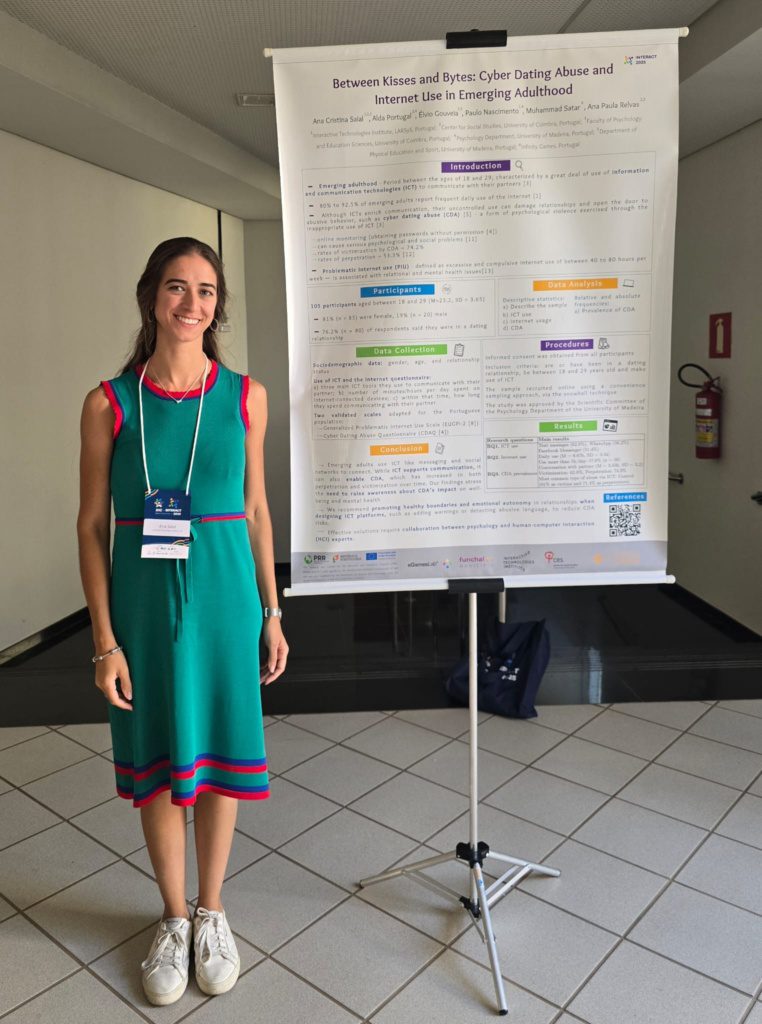
Ana Cristina Saial investigates Digital Intimacy and Game-Based Interventions to prevent online and intimate partner violence
Ana Cristina Saial, researcher at the Interactive Technologies Institute (ITI), has recently published two studies that examine how digital technologies shape intimate relationships among emerging adults and how interactive, game-based approaches can contribute to the prevention of violence in these contexts.
The first study, “Between Kisses and Bytes: Cyber Dating Abuse and Internet Use in Emerging Adulthood,” was presented at INTERACT 2025, held in September in Brazil. Authored by Ana Cristina Saial, Alda Portugal, Élvio Rubio Gouveia, Paulo Nascimento, Muhammad Satar, and Ana Paula Relvas, the research explores the use of the Internet and Information and Communication Technologies by emerging adults aged 18–29 in their intimate and romantic relationships. The study characterizes problematic Internet use and diagnoses the prevalence of online dating violence within this age group. The findings highlight the need to invest in prevention measures and strategies specifically addressing dating violence in digital contexts. The authors emphasize the importance of engaging young people through interactive and technology-based approaches, such as digital games and mobile applications, to promote awareness and support attitude change.
DOI: https://doi.org/10.1007/978-3-032-05008-3_33
Building on this focus, the second study, “When Play Gets Serious: Can a game-based mobile application serve as an intervention for preventing intimate partner violence among emerging adults?”, was presented at CHI Play 2025, held in October in Pittsburgh. Authored by Ana Cristina Saial, Élvio Rubio Gouveia, Alda Portugal, Beatriz Jardim Peres, Muhammad Satar, and Ana Paula Relvas, the study examines young adults’ perceptions of games and mobile applications as tools for preventing violence in intimate relationships. The research involved a workshop that utilised interactive games to address various types of violence, risk factors, consequences, warning signs, and help-seeking behaviours. Participants reported that the playful and informal format created a safe environment for discussing a sensitive topic, facilitated reflection without diminishing the seriousness of the issue, and supported self-reflection without direct exposure. Notably, 68% of participants stated they would use a mobile application for the prevention of violence in intimate relationships, highlighting benefits such as accessibility and confidentiality.
DOI: https://doi.org/10.1145/3744736.3749356
Together, these studies highlight the potential of digital and game-based approaches to foster empathy, awareness, and reflection around online and intimate partner violence among emerging adults. They also contribute to ongoing work towards the development of a gamified digital intervention for the prevention of intimate partner violence, being co-created with young adults and health professionals.